
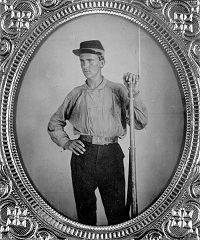
Army ROTC at Florida State University traces its roots to the earliest years of the institution. Founded in 1857 after being authorized by the Florida legislature in 1851, the fledgling school, known as the West Florida Seminary, added classes in military education two years later. This decision proved timely with the outbreak of the Civil War in 1861. The conflict had an enormous impact on the seminary's operations. Enrollment dropped from 250 students in 1860-61 to about 58 in 1864-65. A number of the seminary's professors and students left to join the ranks of the Army, forcing the school to briefly close its doors in early 1862. CPT V. M. Johnson, an 1861 graduate of the Virginia Military Institute, played an integral part in the school's continued operation. He is credited with helping turn the seminary into the Florida Collegiate and Military Institute and improving the quality of the education being offered. In March of 1865, CPT Johnson led a contingent of institute cadets in the Battle of Natural Bridge. For more information on the Battle of Natural Bridge, visit American Battlefield Trust.
In 1905, West Florida Seminary became the Florida State College for Women in accordance with the Buckman Act. During this time, there was no military science department. However, in 1946, as a result of the great influx of men returning to school on the G.I. Bill following World War II, the school once again became coeducational in order to accommodate an overflow of students from Gainesville. The following year, the official name of the school was changed to the Florida State University. The modern Army ROTC program at Florida State was re-established as the Seminole Battalion in 1951 providing junior leaders essential for all components of the United States Army – Active Duty, Army Reserve and Army National Guard. Fourteen Seminole Battalion commissionees have made the ultimate sacrifice in service to the country – 11 in the Vietnam War and three in the Global War on Terror.